Table of Contents
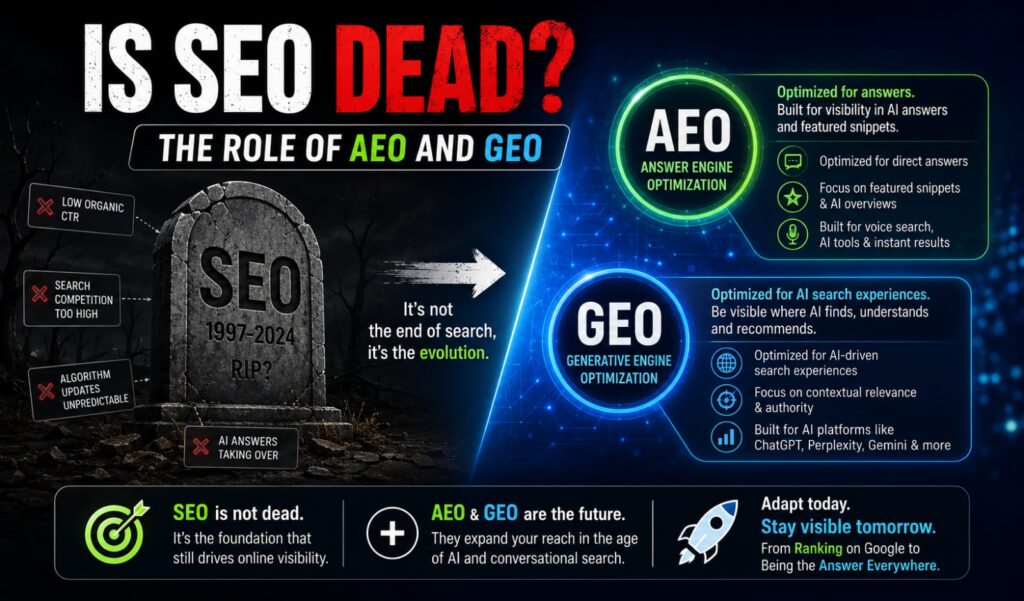
Many people ask, “Is SEO dead?” The short answer is No. SEO is not dead. Instead, it is changing because search engines are becoming smarter with Artificial Intelligence (AI).
Today, users do not only search on Google. They also use AI tools like ChatGPT, Gemini, Perplexity, and Microsoft’s Copilot to find answers. Instead of showing only a list of websites, these platforms provide direct answers.
This shift has introduced two new concepts: Answer Engine Optimization (AEO) and Generative Engine Optimization (GEO). These strategies help websites appear in AI-generated answers while traditional SEO continues to improve rankings on search engines.
If you want your website to stay visible in 2026 and beyond, understanding SEO, AEO, and GEO is essential.
What Is SEO?
SEO (Search Engine Optimization) is the process of improving a website so it appears higher in search engine results.
The main goal of SEO is to increase organic traffic without paying for advertisements.
Traditional SEO focuses on:
- Keyword research
- High-quality content
- Technical SEO
- Mobile-friendly websites
- Fast page speed
- Backlinks
- User experience
SEO has evolved over the years, but its purpose remains the same: helping users find useful and trustworthy information.
Is SEO Really Dead?
No, SEO is far from dead.
What has changed is how people search and how search engines deliver information.
Previously, users clicked through multiple websites to find answers. Today, AI-powered search engines summarize information and provide instant responses.
This means websites need to optimize not only for Google Search but also for AI-powered answer engines.
Instead of replacing SEO, AI has expanded it.
Think of SEO as the foundation. AEO and GEO are the next layer built on top of it.
Why Search Is Changing?
Several major changes have transformed search behavior.
AI-Powered Search
Search engines now understand context instead of matching keywords alone.
Voice Search
People ask complete questions instead of typing short phrases.
Example:
Instead of:
“best SEO tips”
People ask:
“What are the best SEO tips for beginners?”
AI Assistants
Users increasingly rely on AI assistants to summarize information before visiting websites.
Because of these changes, content must answer questions clearly and accurately
What Is AEO (Answer Engine Optimization)?
Answer Engine Optimization (AEO) is the practice of optimizing content so AI assistants and search engines can provide direct answers from your website.
Instead of only ranking on Google, AEO helps your content appear in:
- AI Overviews
- Featured Snippets
- Voice Search
- Smart Assistants
- Question-answer platforms
How to Optimize for AEO
Create content that:
- Answers questions clearly
- Uses simple language
- Includes FAQ sections
- Uses structured headings
- Adds schema markup
- Provides trustworthy information
Example:
Question:
What is SEO?
Good AEO Answer:
“SEO is the process of improving a website so it ranks higher in search engines and attracts free organic traffic.”
Clear, direct answers perform better.
What Is GEO (Generative Engine Optimization)?
Generative Engine Optimization (GEO) focuses on making your content easy for AI models to understand, trust, and reference when generating responses.
Unlike traditional SEO, GEO is designed for AI-generated search experiences.
AI systems analyze:
- Content quality
- Accuracy
- Authority
- Context
- Originality
- User intent
The better your content, the more likely AI will use it in its responses.
SEO vs AEO vs GEO
| SEO | AEO | GEO |
|---|---|---|
| Optimizes for search rankings | Optimizes for direct answers | Optimizes for AI-generated responses |
| Focuses on keywords | Focuses on user questions | Focuses on context and authority |
| Google Search | AI Overviews & Voice Search | ChatGPT, Gemini, Perplexity and AI search |
| Organic traffic | Instant answers | AI citations and recommendations |
These three strategies work together rather than compete.
Why SEO Still Matters
Even with AI search, SEO remains important because:
- Websites still need to be discovered.
- Google still indexes webpages.
- AI tools rely on high-quality websites.
- Businesses need organic traffic.
- Strong SEO improves website credibility.
Without SEO, AI systems have fewer reliable sources to reference.
How to Prepare Your Website for the Future
Here are practical ways to combine SEO, AEO, and GEO.
Write for People First
Create useful, original, and helpful content.
Answer Real Questions
Research what users are asking and answer those questions clearly.
Improve Technical SEO
Focus on:
- Fast loading speed
- Mobile optimization
- Secure HTTPS
- Clean website structure
Use Structured Data
Schema markup helps search engines understand your content better.
Build Trust
- Author information
- Updated content
- Reliable sources
- Accurate facts
Create Comprehensive Content
Cover topics in depth instead of writing thin articles.
Example of SEO + AEO + GEO Working Together
Imagine you publish an article titled:
“How to Learn Digital Marketing.”
SEO helps your article rank on Google.
AEO helps Google show your answer in Featured Snippets and AI Overviews.
GEO increases the chances that AI tools like ChatGPT or Gemini reference your content while answering users’ questions.
One article can benefit from all three optimization methods.
Benefits of Combining SEO, AEO, and GEO
Businesses that use all three strategies can enjoy:
- More organic traffic
- Better visibility in AI search
- Higher brand authority
- Increased user trust
- Improved click-through rates
- Better long-term rankings
- Future-ready digital marketing strategy
Common Mistakes to Avoid
Avoid these common errors:
- Keyword stuffing
- Publishing AI-generated content without editing
- Ignoring user intent
- Writing only for search engines
- Using outdated information
- Neglecting mobile optimization
- Skipping structured data
- Publishing duplicate content
Quality always wins.
Frequently Asked Questions (FAQs)
1. Is SEO dead in 2026?
No. SEO continues to evolve. It now works alongside AEO and GEO to improve visibility in both traditional and AI-powered search.
2. What is the difference between SEO and AEO?
SEO improves rankings in search engines, while AEO focuses on providing direct answers for AI assistants, voice search, and featured snippets.
3. What is GEO in digital marketing?
GEO (Generative Engine Optimization) helps content become more visible in AI-generated search results by improving quality, authority, and context.
4. Should businesses use AEO and GEO?
Yes. Businesses that adopt AEO and GEO can reach users who rely on AI tools while maintaining strong organic visibility.
5. Will AI replace SEO?
No. AI will not replace SEO. Instead, SEO is expanding to include AEO and GEO as search technology evolves.
Conclusion
So, Is SEO dead? Absolutely not.
SEO is evolving rather than disappearing. As AI transforms how people search for information, businesses must go beyond traditional optimization.
By combining SEO, Answer Engine Optimization (AEO), and Generative Engine Optimization (GEO), you can build a future-proof digital marketing strategy. Continue creating helpful, trustworthy, and user-focused content while optimizing it for both search engines and AI-powered platforms.
The future belongs to websites that provide genuine value, answer user questions clearly, and build trust. If you adapt to these changes today, your website will be well-positioned to succeed in the evolving world of search.